
Release 2026.10.02.3
The rest of the sprint: the whole shot in one window, decisions that say what they do, props, wardrobe and makeup continuity
5 new9 improved1 fixed
2026.10.02.3Oct 02, 2026ReleaseOct 02, 2026
The rest of the sprint: the whole shot in one window, decisions that say what they do, props, wardrobe and makeup continuity
The Shot window holds the whole shot; every decision says what it opens, sends back and costs; interpretive fields say where they came from; props, wardrobe and makeup have continuity of their own; the crew feed has channels; a production has a language; Casting checks characters against the screenplay. And: a missing controlling idea is an exception you decide, dialogue says where it is heard from, only what is heard goes to sound, and a poster is not progress.
ImprovedDirectorA screenplay with no controlling idea says so. The Director, Structure and the Producer's script info show it as an exception: write the idea, or waive it with a reason — either goes in the record, and Breakdown keeps it as an open item until someone decides.
ImprovedSoundEvery line of dialogue says where it is heard from — On camera, Off camera, Voice-over or Pre-lap, from the screenplay's own (V.O.), (O.S.) and (PRE-LAP), never guessed — and Needs ADR is a flag of its own with its reason. Spot with Crew is now in History and Costs, and its prompt can be edited.
FixedBreakdownOnly what is heard goes to sound. The breakdown keeps Special effects, Lighting and Sound apart: a practical lamp goes to Lighting, smoke to Special effects, a gunshot's squib to effects and its report to Sound. Breakdowns already made were sorted by the same rule; anything unclear stayed where it was.
ImprovedProducerA poster is marketing, not progress. One-Sheet runs no longer count as the crew's production work or block a scene when they fail; the status report gives them a line of their own and Costs labels their spend Marketing.
NewShotsThe Shot window holds the whole shot. Below its checks: the camera package, the light plan's step and its three zones, continuity — vetoes, waivers, what went stale and why — QC, and the full approval log, each with a button to the department that edits it.
ImprovedDecisionsA decision says what it will do before you make it. Approve says what it opens; Revise and Reject say who the work goes back to, what goes stale and roughly what the rerun costs, on whose key; Waive says what closes unmet.
ImprovedScenesA scene's function, charge and summary say where they came from — the screenplay, the agent, or a person — with their history. A Re-prep never overwrites what a person wrote or approved; it offers its new reading beside it.
ImprovedSoundEvery line on the cue sheet carries its editorial facts: the take it plays on, sync, a lock to that take, its revision and who approved it — and it warns when the picture under an approved line changed.
ImprovedCrewThe crew feed has channels: Decisions, Blockers, Outputs, Log and Conversation, each switched on or off, with a count of what is new in a hidden one.
ImprovedProduction DesignThe set has one owner per fact. The Production Designer's time of day, light and palette are read, not retyped, by the DoP and the Gaffer; the DoP agrees the set for the coverage before deciding the look. The set's time of day now reaches the video prompt.
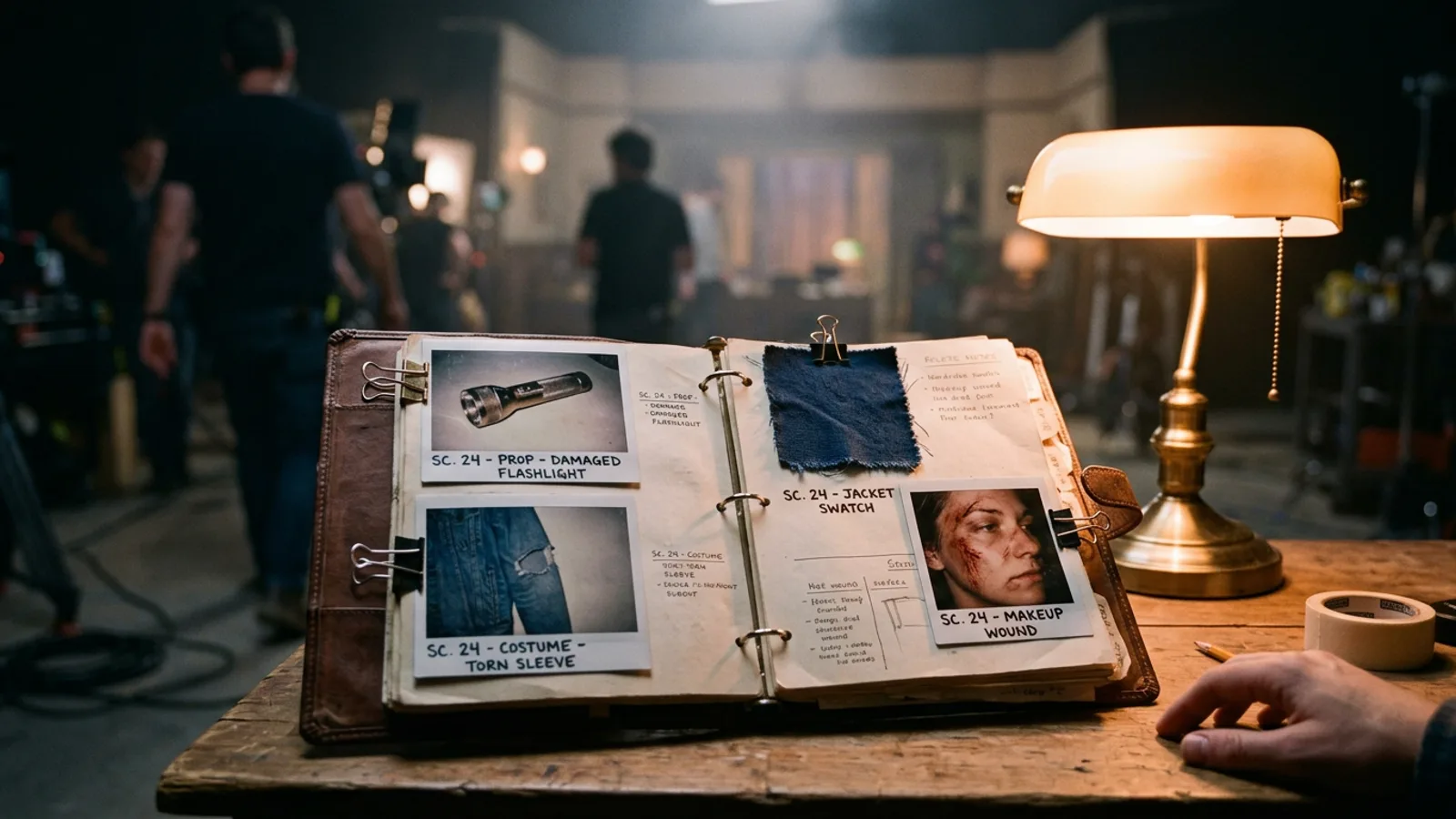
NewPropsProps and set dressing are two inventories, each item joined across its scenes, with its state in every scene — intact, in use, damaged, destroyed — and its multiples worked out from them. An item's description is approved first, then it is found, built or designed; generating a reference is no longer the default.
NewCostumeA continuity plot for wardrobe: each character's scenes by script day, in story order, with the look worn, its condition, why it changes, and its multiples. Continuity now reads the story's order, so a flashback no longer reads as going backward.
NewMakeupMakeup shows each look's progression: where it starts, the script days it spans, its wound stage or intensity, its approved reference — and flags a scene that contradicts it.
NewLanguageA production has a language. The crew is told which language to write in; project text keeps its original wording.
ImprovedCastingCasting checks a character against the screenplay — age, gender, hair, build and more against the casting description and the prompts, and, on request, Claude against the approved picture. Contradictions are warnings with Fix description and Accept as is, in Casting and before a render.
← Older · 2026.10.02.2The Producer's validation, one owner per light, help on every screenNewer · 2026.10.02.4 →Keyboard everywhere, coverage, continuity between scenes, pickers by outcome
STANISLAVSKY · the directing room for AI film crews